
Steel Billet, Bloom, and Slab Differences: A Comparison Guide

Steel Billet, Bloom, and Slab Differences
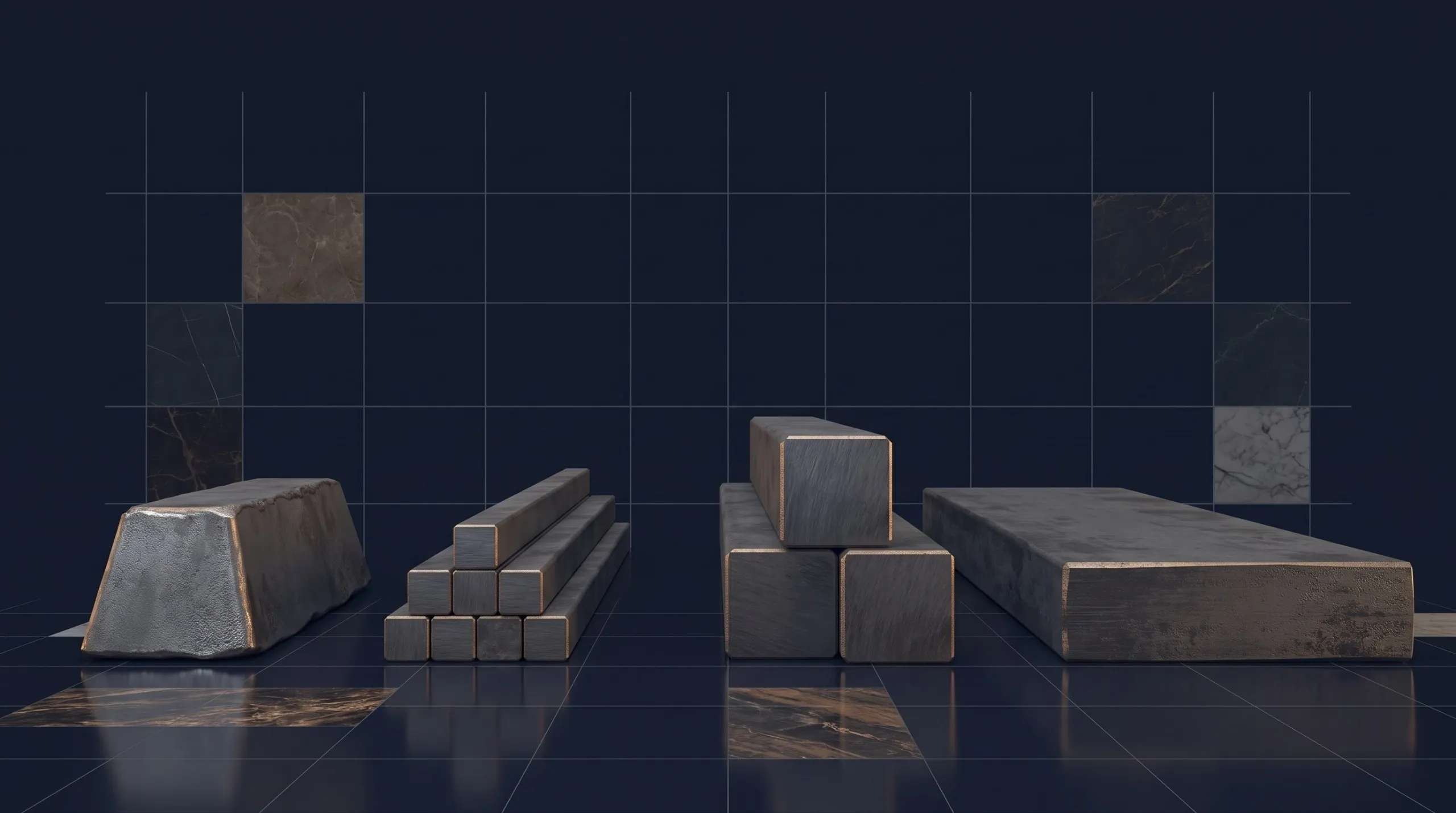
In the steel production chain, several products are manufactured between steel melting and the production of finished goods. Ingots, billets, blooms, and slabs are among the most important of these products. However, their similar appearance sometimes leads people to use these terms interchangeably. In reality, differences in cross-sectional shape, dimensions, production methods, and—most importantly—the final products they are designed to produce make each one suitable for specific applications.
If you are purchasing steel raw materials, understanding the steel billet, bloom, and slab differences is more than a technical matter. These differences can directly affect price, rolling compatibility, the type of final product, and overall production costs.
In this technical guide from Hamgar Holding, we examine the metallurgical characteristics, dimensions, production methods, standards, and applications of these four semi-finished steel products. A comprehensive comparison table is also provided to help you make an informed selection.
What Are Semi-Finished Steel Products, and Why Is It Important to Distinguish Them?
Steelmaking is a multi-stage process that begins with iron ore extraction or scrap melting and ends with finished products such as rebar, beams, pipes, and steel sheets. Molten steel produced in electric arc furnaces (EAF), induction furnaces, or basic oxygen converters cannot usually be turned directly into finished products with precise dimensions. It must first solidify into a standardized, transportable shape. These products are known as semi-finished steel products.
Understanding the differences between billets, blooms, and slabs is essential for several reasons:
- Rolling-line compatibility: Rolling mills for long products use machinery that differs significantly from equipment used for flat steel products.
- Cost estimation and material waste: Purchasing the wrong dimensions can lead to waste and reduced production efficiency.
- Market analysis and price fluctuations: Billet demand, which is influenced by the construction market, differs from slab demand, which is linked to industries such as automotive manufacturing and household appliances.
1. Steel Ingots: The Starting Point for Semi-Finished Products
In everyday market terminology, the word ingot is sometimes used to refer to all semi-finished steel products. In metallurgical engineering, however, an ingot has a specific definition.
Ingot Specifications and Production Method
Steel ingots are generally produced through mold casting. In this method, molten steel is poured into individual molds, often made of cast iron, with trapezoidal or tapered shapes. Once the steel has cooled and solidified, the shape allows it to be removed from the mold more easily. Because the cross-section is often tapered or uneven, ingots are typically short, often less than two meters long.
Applications and Limitations of Ingots
- Applications: Small-scale workshop operations, heavy cast components, forging, and limited-volume production of certain specialty alloy steels.
- Limitations: Potential metallurgical non-uniformity, shrinkage cavities near the upper part of the ingot, and lower production rates compared with continuous casting.
2. Steel Billets: A Common Feedstock for the Construction Industry
A billet is one of the most widely used and in-demand semi-finished steel products in the domestic market and construction projects.
Billet Dimensions and Geometry
Billets typically have a square or circular cross-section. Their defining geometric feature is a relatively small cross-sectional area.
- Cross-sectional dimensions: Square billets commonly range from 100 × 100 mm to 200 × 200 mm, with some reaching approximately 230 mm. In the Iranian market, 130 × 130 mm and 150 × 150 mm are among the commonly used sizes.
- Length: Billets are commonly produced and cut into 6-meter and 12-meter lengths.
Production Methods and Standards
Billets are mainly produced through continuous casting, which can provide a more consistent structure when the process is properly controlled.
- Common grades in Iran: Construction grades such as 3SP, often used where greater ductility is required, including certain wire rod applications, and 5SP, commonly used for reinforcing bar production.
- Standards: Applicable standards depend on the steel grade and intended product. Examples may include ASTM, DIN, and Iranian national standards (ISIRI), but the relevant standard should be verified for each specific application.
Applications of Billets
- Production of plain and deformed reinforcing bars
- Production of wire rod, steel wire, and coils
- Production of some smaller structural sections, such as light angles and channels
3. Steel Blooms: Larger Sections for Heavy Industrial Applications
A bloom is a semi-finished steel product with a larger cross-section than a typical billet. In Persian steel terminology, it is also known as shamsheh.
Bloom Dimensions and Geometry
- Cross-section: Blooms generally have a square or rectangular cross-section with a larger area than billets. Their dimensions are often above 230 × 230 mm, although the exact classification depends on the applicable standard and producer.
- Length: Like billets, blooms are commonly supplied in lengths of approximately 6 to 12 meters.
How Blooms Differ from Billets in Performance
Because blooms have larger cross-sections, the rolling process may require heavier equipment and greater forming forces. As a result, blooms are commonly used as feedstock for mills producing heavy structural and industrial sections.
Applications of Blooms
- Production of heavy structural beams, including certain I-beam and H-beam sections
- Production of railway and metro rails
- Production of large channels and angles
- Production of industrial shafts and axles for machinery manufacturing
4. Steel Slabs: Flat Feedstock for Steel Sheet Production
A steel slab, also known as a flat, is a semi-finished product with a distinctly different geometry from billets and blooms. While billets and blooms are primarily used to manufacture long products, slabs are designed mainly for the production of flat steel products.
Slab Geometry and Physical Characteristics
Slabs have a wide, rectangular cross-section in which the width is much greater than the thickness.
- Thickness: Commonly around 200–250 mm, although thin-slab casting technologies can produce slabs with considerably lower thicknesses, sometimes around 50 mm.
- Width: Generally around 650–2,000 mm, with some products reaching approximately 2,200 mm.
- Length: Commonly around 4–12 meters, depending on the production process and specifications.
Steel Grades and Slab Applications
Slabs are produced in a range of steel grades, including commercial grades such as ST37 and ST52, pipeline grades such as API steels, and stainless steel grades. The appropriate grade depends on the intended application and required mechanical and chemical properties.
Applications of Slabs
- Hot rolling to produce hot-rolled coils and black steel sheets
- Production of cold-rolled, galvanized, and pre-painted steel sheets
- Production of large-diameter oil and gas transmission pipes, including spiral-welded and longitudinally welded pipes
- Applications in shipbuilding, tanker manufacturing, automotive production, and pressure vessel manufacturing
Steel Product Comparison Table: Ingots, Billets, Blooms, and Slabs
When selecting feedstock for a rolling line, ingots, billets, blooms, and slabs should not be treated as interchangeable names for the same product. The following table summarizes their key characteristics to support technical evaluation and purchasing decisions.
| Feature | Ingot | Billet | Bloom | Slab |
|---|---|---|---|---|
| Product type | Primary cast product | Semi-finished product | Semi-finished product | Semi-finished product |
| Typical shape | Often tapered or multi-sided | Small square or rectangular; sometimes round | Larger square or rectangular section | Wide, flat rectangle |
| Cross-section | Varies by mold | Generally smaller than a bloom | Generally larger than a billet | Wide relative to thickness |
| Common production method | Mold casting | Continuous casting or other applicable processes | Continuous casting or other applicable processes | Continuous casting |
| Typical end products | Feedstock for further processing | Rebar, wire rod, and lighter long products | Heavy beams, rails, and heavy sections | Sheets, coils, and other flat products |
| Related rolling process | Primary or subsequent rolling | Long-product rolling | Heavy-section rolling | Flat-product rolling |
| Dimensional requirements | Highly important | Highly important | Highly important | Highly important |
| Key geometric feature | Depends on mold design | Compact, relatively small section | Larger cross-section | Width substantially greater than thickness |
| Main application | Further processing or rolling | Long steel products | Heavy long steel products | Flat steel products |
| Applicable standards | Depend on steel type and application | Depend on grade and final product | Depend on grade and application | Depend on grade and flat-product requirements |
Comparing Billet, Bloom, and Slab Prices and Supply Chains
The prices of these products depend on several factors that should be considered before placing an order.
- Energy costs and processing value: Rolling and casting costs vary according to the product dimensions, process requirements, and degree of dimensional control.
- Downstream supply and demand: One important difference between billets, blooms, and slabs is the market that drives demand. Billet demand is closely linked to construction activity and rebar prices, while slab demand is influenced by flat steel consumption in sectors such as automotive manufacturing, household appliances, and pipeline production.
- Producer and product specifications: Major producers, including Khuzestan Steel, Mobarakeh Steel, Hormozgan Steel, Isfahan Steel, and Chadormalu, serve different market segments and may offer different dimensional tolerances and product specifications.
The commercial team at Hamgar Holding monitors the steel market and works with established suppliers to help buyers source suitable materials. Buyers should confirm product specifications, quality documentation, supply conditions, and delivery terms before finalizing an order.
What Should You Consider When Buying Billets, Blooms, or Slabs?
If you are purchasing steel for commercial or manufacturing purposes, begin with the intended end product rather than simply choosing a product by name.
1. Identify the Final Product
First, determine what you plan to manufacture. Billets are commonly used for rebar and wire rod, blooms are more suitable for many heavy long products, and slabs are the relevant feedstock for sheets and coils.
2. Check Your Production Line Dimensions
The dimensions of the incoming material must be compatible with your rolling equipment. Hamgar Holding offers billets in 100 × 100 mm and 120 × 120 mm sections, according to the product information provided. Confirm current availability and specifications before ordering.
3. Review the Chemical Analysis
Carbon, manganese, silicon, sulfur, phosphorus, and alloying elements can affect rolling performance and the mechanical properties of the finished product. Always check the material test certificate against the requirements of your production process.
4. Check Surface and Internal Quality
Surface cracks, internal defects, segregation, and casting-related issues can lead to additional costs during downstream processing. Quality inspection and documentation are important parts of the purchasing process.
5. Evaluate the Total Cost, Not Just the Price
A lower purchase price does not always mean a more economical choice. If the product’s dimensions, grade, or quality are incompatible with your production line, rework, material waste, and production downtime can outweigh the initial price difference.
Hamgar Holding’s Role in Steel Product Supply
Hamgar Holding began operating in the steel and casting sector in 2005. According to the company’s profile, it has more than 20 years of experience and operates several subsidiaries and brands involved in the production of billets, ingots, and other steel products.
One of its associated businesses, Saba Rad Mehvar, works in iron scrap processing, melting, continuous billet casting, and quality control.
For industrial buyers and rolling mills, an established supply chain can be important. Supplier evaluation should consider not only price but also production capacity, consistency of quality, continuity of supply, technical specifications, and delivery performance.
Conclusion: Which Steel Product Is Right for Your Needs?
When deciding whether to use a billet, bloom, or slab, the right choice depends on the final product, production-line specifications, and intended application.
Billets are commonly used to manufacture lighter long products such as reinforcing bars and wire rod. Blooms, with their larger cross-sections, are suitable for many heavy structural and industrial products. Slabs, because of their wide, flat geometry, are the primary feedstock for steel sheets and coils. Ingots are technically distinct from these continuously cast semi-finished products and generally refer to steel cast into individual molds.
In practical terms:
- For rebar and wire rod production, billets are the typical choice.
- For heavy beams, H-sections, or rails, blooms may be the appropriate feedstock.
- For steel sheets, coils, and many flat-product applications, slabs are the relevant material.
- For special cast components, forging, or certain specialty alloy-steel applications, ingots may be suitable.
If you are considering purchasing steel billets, review the specifications and available products on the Hamgar Holding steel billet page. Steel slabs are also part of the wider supply chain for flat steel products.
Frequently Asked Questions
1. What is the difference between a billet, bloom, and slab?
The main differences are their cross-sectional shape, dimensions, and intended applications. Billets generally have smaller square or rectangular sections and are used to produce rebar and wire rod. Blooms have larger cross-sections and are used for heavy sections such as beams and rails. Slabs have wide, flat cross-sections and are used to manufacture steel sheets and coils.
2. Should I buy billets or slabs to produce steel sheets?
For steel sheets and other flat steel products, slabs are the relevant feedstock. Their wide cross-section makes them suitable for flat rolling. Billets are mainly used to produce long products such as rebar, wire rod, and certain steel sections.
3. Can a bloom be used instead of a billet in a production line?
Although both are steel products, they are not automatically interchangeable. A bloom has a larger cross-section, and using it in a line designed for billets may require different processing conditions and could increase costs and equipment wear. The choice should be based on the rolling mill’s technical specifications.
4. Why do billet, bloom, and slab prices fluctuate?
Prices are influenced by factors such as scrap and direct reduced iron costs, energy prices, exchange rates, production conditions, and downstream demand. For example, stronger construction activity may increase billet demand, while growth in flat steel consumption can affect slab demand.
5. What should buyers check before ordering semi-finished steel products?
Buyers should confirm the required dimensions, steel grade, chemical composition, surface and internal quality, applicable standards, quality certificates, delivery conditions, and total cost. These details help ensure that the material is compatible with the intended production process.
For technical guidance, current price inquiries, or orders for billets and other steel products, contact the sales team at Hamgar Holding.