
Induction Furnace vs. Electric Arc Furnace for Billets

Introduction: How Does Furnace Selection Affect Steel Billet Production?
Selecting a melting technology is an important decision when designing and optimizing steelmaking plants, as it directly affects production costs, molten steel quality, operating capacity, and production-line efficiency. Among electric melting technologies, induction furnaces and electric arc furnaces are important options for producing steel used in billets and other semi-finished steel products.
In this article, Hamgar Holding examines the differences between induction furnaces and electric arc furnaces from technical and economic perspectives to help manufacturers make more informed decisions when selecting a suitable technology for steel billet production.
How Do Induction Furnaces and Electric Arc Furnaces Work?
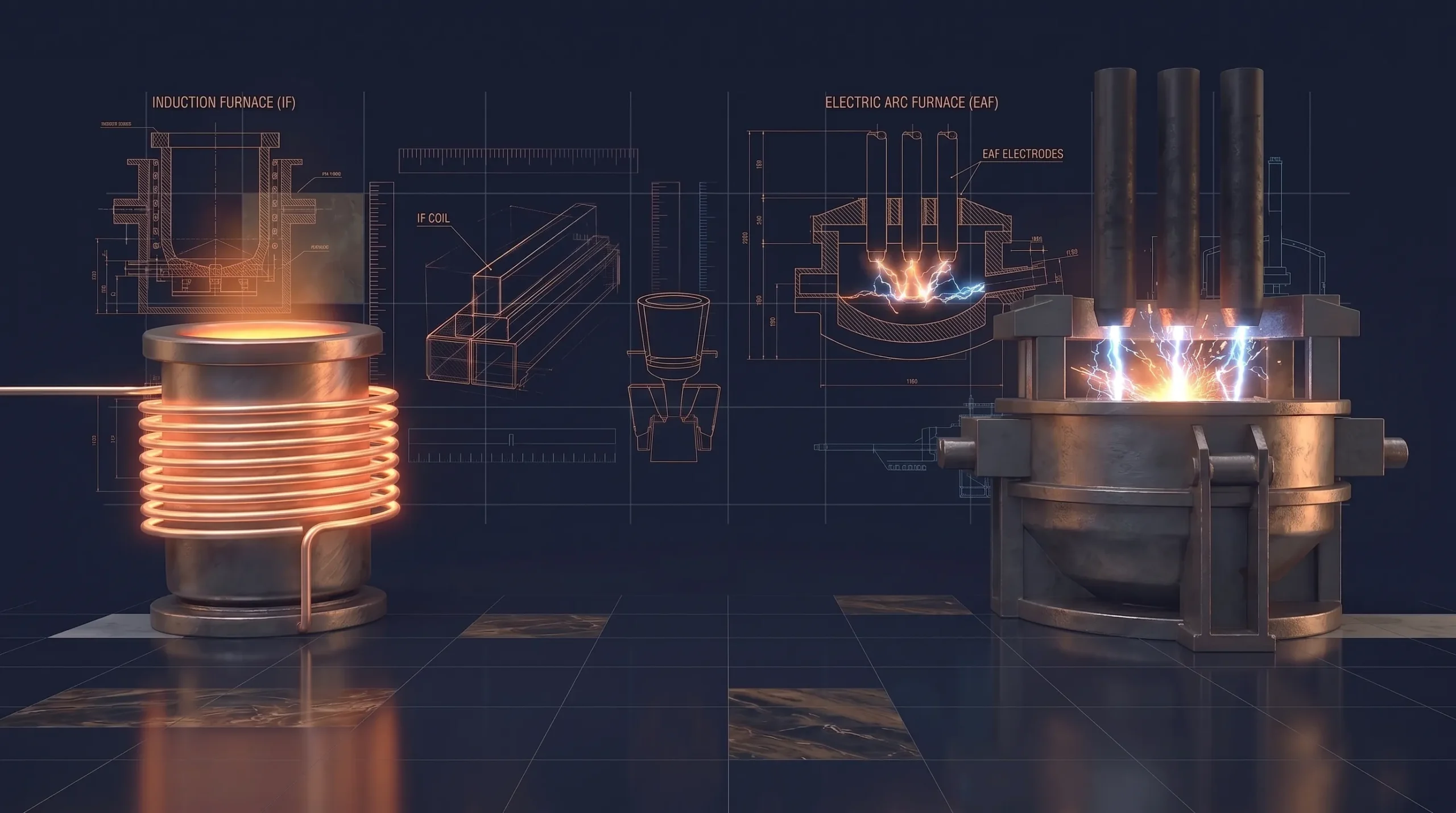
Induction Furnace (IF)
An induction furnace uses electromagnetic induction to generate electrical currents within the metallic charge. These currents produce heat, gradually melting the raw materials. In this technology, an induction coil creates an alternating magnetic field, transferring energy to the metal without direct contact between an electrode and the molten steel.
One important feature of an induction furnace is electromagnetic stirring, which helps maintain a relatively uniform temperature and distribute alloying elements throughout the melt. However, induction furnaces generally have limited independent refining capabilities, particularly for effectively removing phosphorus and sulfur. Consequently, raw material quality and chemical composition control are especially important from the beginning of the process.
Electric Arc Furnace (EAF)
In an electric arc furnace, energy is transferred through an electric arc between graphite electrodes and the metallic charge or molten metal. The high temperature of the arc enables rapid melting and supports metallurgical reactions. EAFs are commonly used to melt steel scrap, direct reduced iron (DRI), or combinations of iron-bearing materials.
One of the main advantages of this furnace is its ability to manage slag, inject oxygen, and adjust oxidation and reduction conditions to achieve better control over molten steel composition. When the process is properly designed and operated, these capabilities provide greater flexibility for producing steel grades with different specifications.
Comparing Energy Consumption and Steel Melting Costs: Induction Furnace vs. Electric Arc Furnace
Energy consumption is one of the main indicators used to evaluate the economics of steelmaking furnaces. However, an accurate comparison between an induction furnace and an electric arc furnace must consider electricity consumption in kilowatt-hours per tonne of molten steel, charge conditions, equipment efficiency, and total operating costs.
In an induction furnace, energy is transferred through an electromagnetic field. The absence of an electric arc can reduce losses associated with arc radiation. Combined with appropriate process control, this feature can support good energy efficiency. However, the specific electricity consumption of an induction furnace is not necessarily lower than that of an EAF. It depends on furnace capacity, design, molten steel holding time, and operating conditions.
An electric arc furnace, by contrast, can use not only electricity but also chemical energy generated through oxygen injection and fuel. In many industrial facilities, these inputs can reduce specific electricity consumption and increase melting speed. However, the costs of graphite electrodes, slag-forming materials, oxygen, and equipment maintenance must also be included in the calculation.
To make a final decision between an induction furnace and an electric arc furnace, manufacturers need to evaluate the total cost per tonne of sound steel suitable for casting. Electricity prices, demand charges, power factor, raw material costs, metallic yield losses, and maintenance-related downtime can all change the outcome of the comparison. Furnace selection should therefore be based on actual plant data rather than a single general energy-consumption figure.
Molten Steel Quality and Chemical Composition Control
Molten steel quality is a determining factor in producing standard-compliant billets. Variations in chemical composition, impurities, and casting temperature can affect the final product’s quality and performance during rolling.
Electromagnetic stirring in an induction furnace helps achieve relatively uniform molten steel temperatures and a more even distribution of alloying elements. The absence of a direct electric arc can also limit certain oxidation conditions. However, these characteristics do not mean that impurities are automatically removed. If scrap contains copper, tin, or other undesirable residual elements, an induction furnace generally cannot effectively remove many of them.
In an electric arc furnace, slag formation and control, together with oxygen injection, can support a wider range of refining reactions when these operations are compatible with the process design. For example, phosphorus removal depends on suitable oxidizing conditions and slag characteristics, while sulfur removal generally requires appropriate slag conditions and a reducing environment. Consequently, the metallurgical capabilities of an EAF can offer advantages when producing steel grades with stringent refining requirements.
With both induction furnaces and electric arc furnaces, chemical composition must be controlled through sampling, laboratory analysis or spectrometry, ferroalloy adjustments, and molten steel temperature management. Final billet quality does not depend solely on the furnace type. Charge quality, ladle metallurgy, continuous casting systems, and solidification control also play essential roles.
Production Capacity and Plant Economics
Induction furnaces are generally suitable for facilities that need flexibility in batch size, grade changes, and production planning. This technology can be an appropriate choice for small and medium-sized plants or production lines with varied manufacturing schedules. However, actual capacity depends on electrical power, furnace size, melting time, and the number of operating units.
Electric arc furnaces, particularly high-power industrial designs, are widely used for large-scale steel production and supplying continuous casting lines. Coordinating melting time, ladle transfer, and casting speed is essential to maintaining line efficiency. In these operations, annual production capacity, downtime, and equipment utilization rates are particularly important.
Nevertheless, production capacity cannot be determined by furnace type alone. A plant’s actual output depends on heat size, cycle time, equipment availability, ladle capacity, and continuous casting machine capacity. Economic comparisons must therefore consider the entire production line, not just the melting furnace.
Comparing Raw Materials and Operational Flexibility
Induction furnaces generally require more tightly controlled raw materials because their limited refining capabilities make it difficult to correct certain impurities during melting. Using sorted scrap, DRI with suitable specifications, and carefully controlling residual elements can help maintain consistent product quality.
Electric arc furnaces can accommodate a wider range of combinations of scrap, DRI, and other iron-bearing materials. However, this flexibility does not eliminate the need for raw material control. Suitable scrap selection and residual element management remain essential for achieving the target steel grade.
Regarding the capital investment costs of induction furnaces and electric arc furnaces, induction furnaces may be more economical at certain lower production capacities because of their configuration and auxiliary equipment requirements. In contrast, EAF installations typically require substantial electrical infrastructure, electrode systems, fume collection equipment, and process control systems. Actual investment costs depend on design capacity, automation level, environmental requirements, and the plant’s location.
Which Furnace Is Better for Steel Billet Production?
If a plant prioritizes flexible melting operations, smaller-scale production, and the use of carefully controlled raw materials, an induction furnace may be a suitable option—provided that the metallurgical requirements of the target steel grades are compatible with the process.
By contrast, if a plant requires high production capacity, continuous output, greater flexibility in charge management, and broader refining capabilities, an electric arc furnace may be the more appropriate choice. However, its advantages depend on production-line design, raw material quality, energy costs, and operational expertise.
Before choosing between an induction furnace and an electric arc furnace, procurement engineers and technical consultants should evaluate at least the following factors:
- Required annual production capacity
- Target steel grades
- Specifications of scrap and direct reduced iron
- Limitations of the electrical grid
- Initial capital investment
- Maintenance and repair costs
- Required billet quality standards
It is also important to determine whether final refining will take place inside the furnace or whether secondary steelmaking equipment, such as a ladle furnace, is available in the production line.
Conclusion
Induction furnaces and electric arc furnaces are both viable technologies for melting steel, but they do not offer identical advantages. Induction furnaces can be suitable for flexible production using controlled raw materials, while EAFs play an important role in many large-scale steelmaking operations because of their high capacity and broader refining capabilities.
For high-quality billet production, the final choice should be based on total production costs, required chemical composition, plant capacity, and downstream equipment. Hamgar Holding recommends evaluating both options using actual operating data to ensure that the final decision aligns with production objectives and product standards.