
Steel Billet Applications: Rebar, Wire Rod, and Profiles

What Role Does Steel Billet Play in Industry?
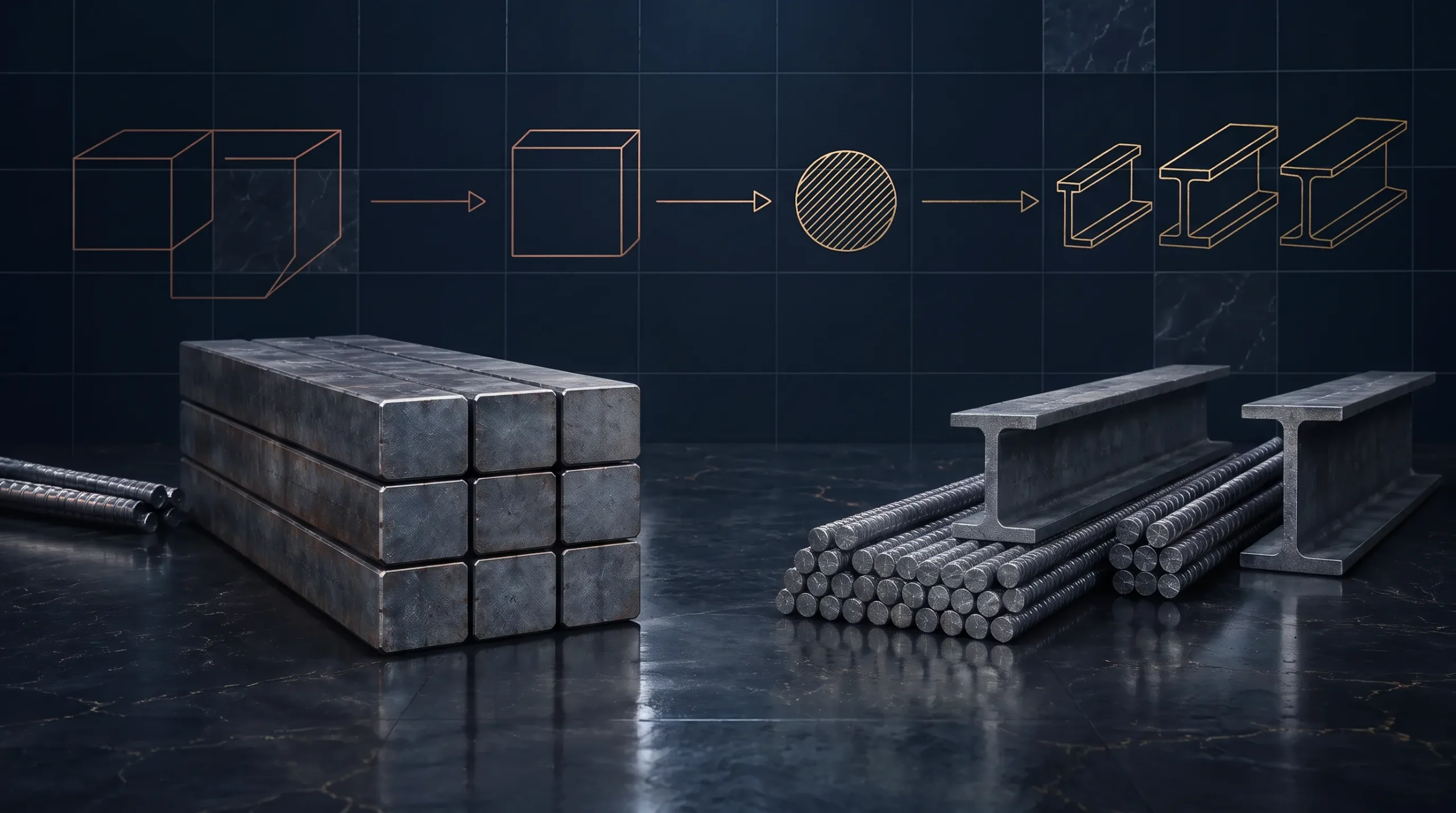
Steel billet is an important raw material used to manufacture long steel products. After steelmaking and casting, this semi-finished product is transferred to rolling mills, where industrial rollers transform it into various products, including rebar, wire rod, and certain structural sections.
Steel billet applications depend on its chemical composition, dimensions, surface quality, and the type of final product. Selecting the right billet can improve production efficiency, reduce waste, and enhance the quality of finished products.
For small and medium-sized rolling mills, understanding steel billet applications and the criteria for selecting suitable billets is particularly important because raw material quality directly affects production costs and rolling mill performance. In this article, Hamgar Holding examines the process of converting billets into finished products and the key considerations for each application.
The Production Chain: From Billet to Finished Product
To understand steel billet applications, it is first necessary to become familiar with the stages involved in converting billets into finished products.
The process begins with molten steel production and chemical composition adjustment. The steel is then formed into billets through continuous casting. After cutting and quality inspection, the billets are transferred to a rolling mill.
At the rolling mill, billets are heated to the appropriate temperature in a reheating furnace and passed through a series of rollers. During this stage, the cross-sectional area decreases and the product gradually changes shape until it reaches the required dimensions.
The type of rollers, number of rolling passes, line speed, and cooling method are determined by the final product. Therefore, although billets are a common raw material for many products, the required billet specifications are not the same for every production line.
Steel Billet Applications in Rebar Production
One of the most important steel billet applications is the production of reinforcing steel bars, commonly known as rebar. Rebar is used to reinforce concrete in buildings, bridges, foundations, and infrastructure projects.
Rebar Production Process
First, a billet with the appropriate grade and dimensions is selected. It is then heated in a reheating furnace to prepare it for deformation. Next, it passes through rolling stands, where its cross-sectional area is reduced.
In the final stages, specially grooved rollers form the ribs on the rebar surface. The product is then cut, cooled, and subjected to quality inspection.
Characteristics of Suitable Billets for Rebar
Billets used for rebar production must meet the chemical composition and metallurgical property requirements of the finished product standard. Carbon content and other alloying elements affect strength, ductility, and rollability.
Surface cracks, internal defects, and unsuitable dimensional variations can also increase waste or cause production problems. Therefore, checking the chemical analysis certificate and the billet’s surface quality before use is essential.
Steel Billet Applications in Wire Rod Production
Another important application of steel billets is wire rod production. Steel wire rod is manufactured in coils and used in wire drawing, wire mesh, nail and screw manufacturing, and certain industrial components.
Wire Rod Production Process
In this process, billets enter the rolling line after reheating. Their cross-sectional area is reduced through multiple rolling stages until the required diameter is achieved. The wire rod is then coiled and cooled, with quality inspections carried out according to the product requirements.
Criteria for Selecting Billets for Wire Rod
Billets intended for wire rod production must be compatible with the final application and the capabilities of the production line. Suitable chemical composition, structural uniformity, and surface quality are among the most important selection criteria.
These factors are particularly important for wire rods that undergo further wire-drawing operations. Cracks or surface defects may become more pronounced during drawing, increasing the risk of wire breakage and production waste.
Therefore, the mill should determine the required wire rod specifications before purchasing billets and select the appropriate grade and quality accordingly.
Steel Billet Applications in Structural Profile Production
Billets are also used to produce certain structural steel sections, such as angles and channels. In this process, heated billets pass through rollers with specially designed grooves to create the required geometry.
It is important to note that not all structural profiles are produced by directly rolling billets. Many hollow square and rectangular profiles are manufactured by forming steel sheets or strips and then welding them.
For rolled structural sections, the initial billet dimensions, steel quality, and rolling pass design are particularly important. If the raw material is incompatible with the mill’s equipment, controlling the final dimensions becomes more difficult, and production waste may increase.
The finished product must meet the dimensional, geometric, and mechanical property requirements of the relevant standard and intended application. Therefore, selecting suitable billets is an important step in maintaining the quality of manufactured profiles.
Comparison of Billet Applications in Rolling Mills
Each finished product requires different raw material specifications. The following table highlights the main differences.
| Important Billet Selection Criteria | Main Application | Finished Product |
|---|---|---|
| Steel grade, mechanical properties, and rollability | Construction and reinforced concrete structures | Rebar |
| Surface quality, chemical composition, and ductility | Wire, mesh, nails, and screws | Wire rod |
| Dimensions, steel quality, and rolling process stability | Metal structures and industrial applications | Angles and channels |
This comparison shows that steel billet applications are not determined solely by the type of finished product. Equipment capacity, required standards, and production conditions must also be considered.
Important Considerations When Purchasing Steel Billets for Rolling Mills
Small and medium-sized rolling mills should evaluate quality and price together when purchasing billets. A lower price does not necessarily mean a lower total cost because unsuitable billets may cause production line stoppages, increased waste, and reduced product quality.
Before placing an order, check the following:
- Required steel grade and chemical composition
- Cross-sectional dimensions, length, and permitted tolerances
- Surface quality and the absence of unacceptable defects
- Chemical analysis certificate and shipment traceability
- Order tonnage, delivery schedule, and payment terms
The supplier’s ability to deliver billets consistently and on schedule is also important. Proper supply planning can help prevent raw material shortages and unexpected production line stoppages.
Common Mistakes When Selecting Steel Billets for Rolling
Choosing unsuitable billets can reduce finished product quality, increase production waste, and raise factory costs. To make the best use of steel billets, it is advisable to avoid several common mistakes:
- Focusing only on price: A cheaper billet does not necessarily represent a more economical purchase. Raw material quality, waste levels, and rollability must also be included in cost calculations.
- Ignoring chemical composition: The billet’s chemical composition must match the target product and applicable production standard because it affects mechanical properties and finished product quality.
- Selecting unsuitable dimensions: Billet dimensions must be compatible with the factory’s furnace capacity, equipment, and rolling line to prevent production stoppages and higher preparation costs.
- Overlooking quality certificates: Before purchasing, check the billet’s technical specifications and chemical analysis certificate to ensure that the raw material meets the production line’s requirements.
Ultimately, selecting suitable billets for rebar, wire rod, or structural profiles should be based on the final product, factory equipment, and quality requirements. This approach helps reduce waste, improve rolling efficiency, and maintain consistent product quality.
Conclusion: Choosing the Right Billet Is the Foundation of Quality Production
Steel billet applications are important throughout the long steel product manufacturing chain, from reinforcing bars to wire rod and certain structural sections. However, each application requires technical specifications suited to the final product.
Selecting suitable billets for rebar, wire rod, or structural sections should be based on steel grade, surface quality, dimensions, and the capabilities of the rolling line. Raw material quality control, combined with effective production process management, helps reduce waste and improve productivity.
To explore sourcing options, prepare your required technical specifications, steel grade, and order tonnage. Then submit a request for product information or a quotation through Hamgar Holding’s sales contact form.