
Steel Billet Production: A Six-Step Guide to the Manufacturing Process

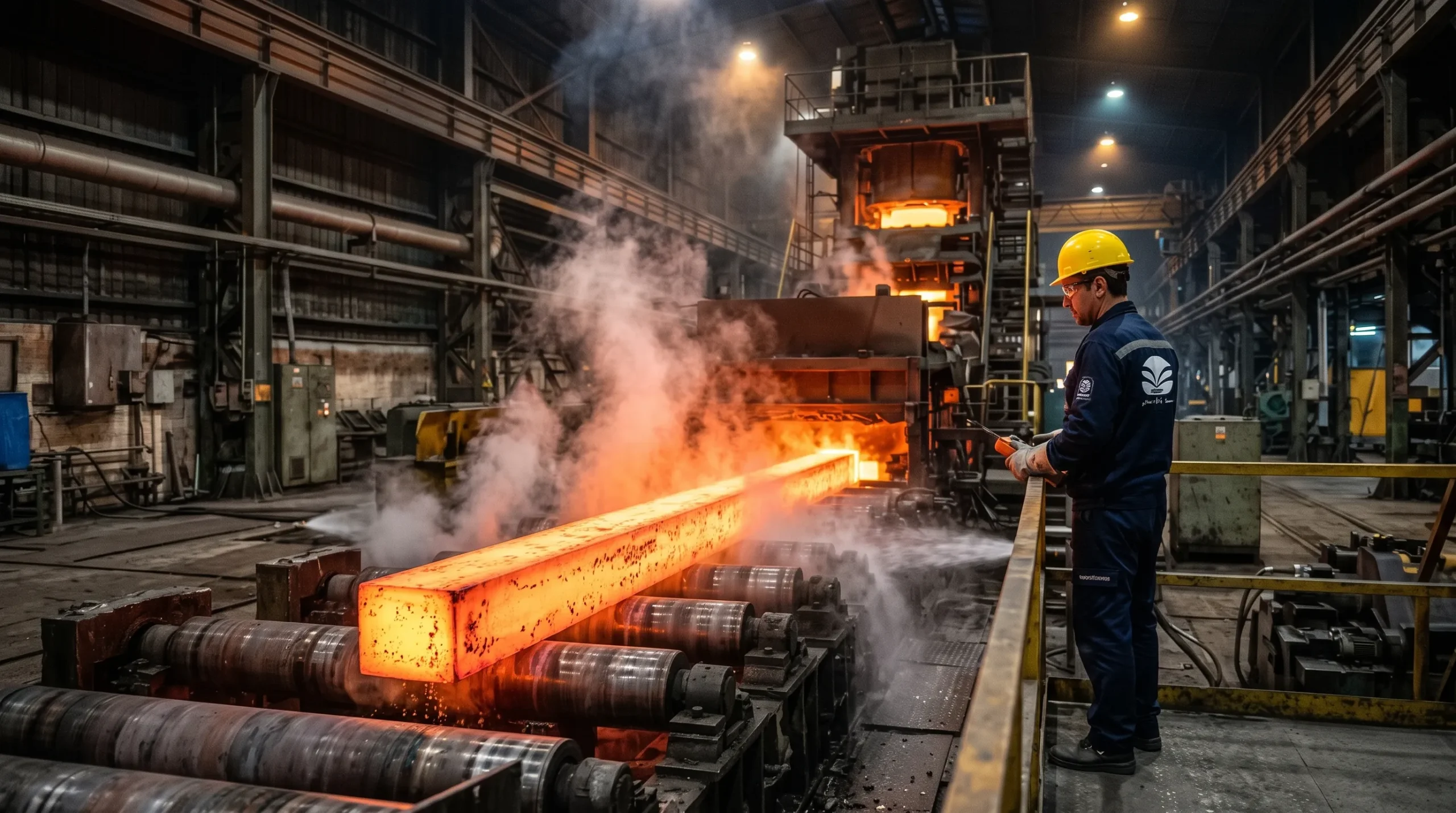
Steel billet production involves much more than melting iron and pouring it into a mold. The quality of the final product depends on raw material selection, molten steel control, solidification, cutting, and billet inspection. If chemical composition, temperature, or cooling conditions are not properly managed at any stage, defects may develop and become apparent during rolling.
A billet is a semi-finished steel product, usually with a square cross-section, used as feedstock for rolling mills. Hamgar Holding carries out steel billet production by melting direct reduced iron (DRI) and scrap in induction furnaces and using a continuous casting line. This comprehensive guide follows the production process through six steps to explain the role of each stage and its relationship to billet quality.
What Is a Steel Billet, and Why Does Its Production Method Matter?
After leaving the casting line, a billet is not yet a finished product such as a reinforcing bar or structural section. It must undergo further processing, usually heating and rolling, to achieve the required shape. For this reason, industrial buyers look beyond a billet’s appearance and dimensions. Chemical composition, surface integrity, cross-sectional uniformity, and suitability for rolling are also important.
For example, surface cracks may propagate during rolling, while non-metallic inclusions can affect the quality of the finished product. These issues cannot be controlled by a single machine or test. Instead, billet quality results from a series of sound decisions throughout the production line. In general, the steel billet production process follows these stages:
Raw Material Preparation
↓
Melting in an Induction Furnace
↓
Molten Steel Adjustment and Preparation
↓
Continuous Casting
↓
Cooling and Cutting
↓
Inspection and Delivery
Let’s examine each stage in more detail.
Step 1: Raw Material Selection and Preparation
Steel billet production begins with selecting suitable materials for charging the furnace. Direct reduced iron (DRI) and steel scrap are the primary materials used for melting. Their type, quantity, and quality must be compatible with the required chemical composition of the billet. Unsuitable scrap may introduce unwanted elements, contaminants, or non-metallic materials into the molten steel, making quality control more difficult.
At this stage of the steel billet production process, scrap is inspected, sorted, and prepared as needed. The objective is to identify unsuitable, contaminated, or potentially problematic pieces before they enter the furnace. DRI must also be stored and used according to the process requirements. Moisture in charge materials is an important safety concern, as introducing wet materials into a molten-metal environment can be dangerous.
Raw material preparation is not merely a storage or handling task. The proportions of the charge affect melting behavior, slag formation, and the ability to achieve the target chemical composition. In simple terms, the more consistent and well-characterized the incoming materials are, the easier it becomes to control subsequent stages.
Step 2: Melting Materials in a Billet Induction Furnace
In the second stage of steel billet production, the prepared materials are charged into a billet induction furnace. An induction furnace uses an electromagnetic field to generate the energy required to heat and melt the metal. Depending on the furnace capacity and operating procedures, the operator manages the charge to maintain a controlled melting process.
The furnace does more than convert solid material into liquid metal. Molten steel temperature, slag quantity and characteristics, and furnace refractory conditions must also be monitored. Under suitable conditions, slag can help remove certain impurities. However, poor slag control or slag entering the molten steel stream can create problems during casting.
One important point that is sometimes overlooked is that a higher temperature does not necessarily mean better quality. The molten steel must be at an appropriate temperature for transfer and casting. An unsuitable temperature can affect both flow behavior and solidification. The exact operating temperature is not a universal fixed value; it depends on the production line and steel grade.
Step 3: Chemical Composition Control and Molten Steel Preparation
Once the steel has melted, its chemical composition must be checked against the target product specifications. In steel billet production, grades are more than commercial labels. The quantities and permissible limits of individual elements affect billet behavior during rolling and the properties of the resulting product. Sampling and evaluating the molten steel are therefore important parts of process control.
If necessary, the chemical composition is adjusted by adding appropriate materials according to the production procedure. Measures must also be taken to limit the transfer of slag and impurities into subsequent stages. The exact sampling, testing, and adjustment methods depend on the plant’s equipment, the required grade, and the production method. Consequently, a single procedure cannot be assumed to apply to every producer.
The prepared molten steel is then tapped from the furnace and transferred to the casting section. During this transfer, safety, temperature management, and the prevention of unwanted material contamination are essential. If the molten steel moves outside the suitable process temperature range before reaching the mold, maintaining stable casting conditions becomes more difficult.
This stage also answers a common question: Why can two billets with similar appearances have different quality levels? Part of the answer lies in the chemical composition and cleanliness of the molten steel, neither of which can be reliably determined by looking at the billet surface alone.
Step 4: Shaping on a Continuous Billet Casting Line
The molten steel now enters the main shaping stage: the continuous billet casting line. In this process, molten steel is continuously fed into a mold with a specified cross-section. Contact with the cooled mold walls forms a solid shell around the molten steel, while the central portion initially remains partly liquid.
The developing strand gradually exits the mold and moves along the steel billet production line. At the same time, molten steel entry conditions, the level inside the mold, strand withdrawal speed, and cooling must remain coordinated. A lack of coordination among these factors can increase the risk of surface or internal defects.
The main advantage of continuous casting is that billets are formed through a continuous process rather than by filling many separate molds individually. However, “continuous” does not mean that the process requires no monitoring. Stable operating conditions must be maintained throughout casting.
At Hamgar Holding, a continuous billet casting line has been commissioned for billets with cross-sectional dimensions of 100 × 100 mm and 120 × 120 mm. These figures refer to cross-section dimensions and should not be confused with billet length, steel grade, or production capacity. Each of these specifications must be considered separately when defining an order.
Step 5: Cooling, Complete Solidification, and Cutting
The strand’s exit from the mold does not mark the end of solidification. After the initial shell forms, the inner sections must gradually solidify as the strand moves along the line. Cooling after the mold therefore plays an important role in the structural quality of the billet. Cooling intensity and distribution must match the operating conditions; uneven cooling can create thermal stresses and increase the risk of defects.
After passing through the designated path, the strand is cut to the required length. Cutting length depends on order specifications, line equipment, and the needs of the next-stage consumer. Cutting must also be performed in a way that leaves the billet dimensions and end conditions suitable for handling and subsequent processing.
At this stage of the steel billet production process, it is sometimes assumed that the faster a billet cools, the sooner it is ready for delivery. In industrial production, however, speed alone is not a measure of success. The objective is to achieve the required solidification conditions while maintaining product quality and stable operations. Cooling control is therefore an integral part of production, not a secondary step after manufacturing.
Step 6: Inspection, Identification, and Final Product Preparation
After cutting, billets must be checked to determine whether they meet the required specifications. Common inspections include dimensional checks, visual examination of the surface, verification of strand shape, and identification of visible defects. Depending on product requirements and order specifications, chemical analysis results and other quality-control tests may also be used to determine whether the product can be accepted.
An important distinction exists between a product being “manufactured” and being “ready for sale.” Before delivery, each billet must be identifiable and traceable to the relevant heat or order. This is important when investigating quality concerns, resolving disputes, or verifying compliance with order documentation.
Once accepted, the billets are grouped and prepared for storage or transport according to the delivery plan. Handling conditions also matter: damage during unloading, loading, or storage can affect a product that was manufactured under carefully controlled conditions. The accompanying documentation should clearly identify the agreed product specifications, including dimensions and steel grade.
Which Factors Have the Greatest Impact on Billet Quality?
The six stages described above are interconnected. Scrap selection affects the molten steel’s chemical composition; composition and temperature influence its behavior in the mold; and mold conditions and cooling affect the integrity of the strand. Quality control should therefore not be limited to visual inspection at the end of the process.
Four areas are particularly important for understanding billet quality: raw material characterization, chemical composition control, casting stability, and product traceability. If any one of these elements is weak, controlling the subsequent stages becomes more difficult.
For example, an acceptable appearance does not prove that the chemical composition meets the required grade. Similarly, a correct chemical composition alone does not guarantee that the billet is free from cracks or surface defects.
For buyers, the best approach is to specify the billet’s intended use in the rolling mill, cross-sectional dimensions, length, required grade, and quality-control documentation before placing an order. For producers, recording process data and linking each heat to its resulting products is fundamental to technical accountability.
Conclusion: Billet Quality Depends on Control Throughout Production
Steel billet production is not simply a matter of combining iron and melting it in a furnace. It is the result of a carefully managed sequence involving technical expertise, process monitoring, and engineering infrastructure. As this guide has explained, every stage—from selecting raw materials in Step 1 to inspecting the finished product in Step 6—plays an important role in determining how the billet performs during rolling.
At Hamgar Holding, we view billet production as more than supplying a standard industrial product. Our goal is to use induction furnaces and continuous casting technology to supply steel products with consistent and reliable characteristics. We understand that the quality of the incoming billet is a key factor in the successful production of finished steel sections.
If you are looking for billets with clearly defined specifications and traceable documentation, we recommend verifying the supplier’s technical records and production conditions before making a final decision. Hamgar Holding is ready to provide further information about its products and their technical specifications for specialized applications. Our technical team is available to discuss your project requirements and provide professional guidance.