
How is the Continuous Slab Casting Process Performed?

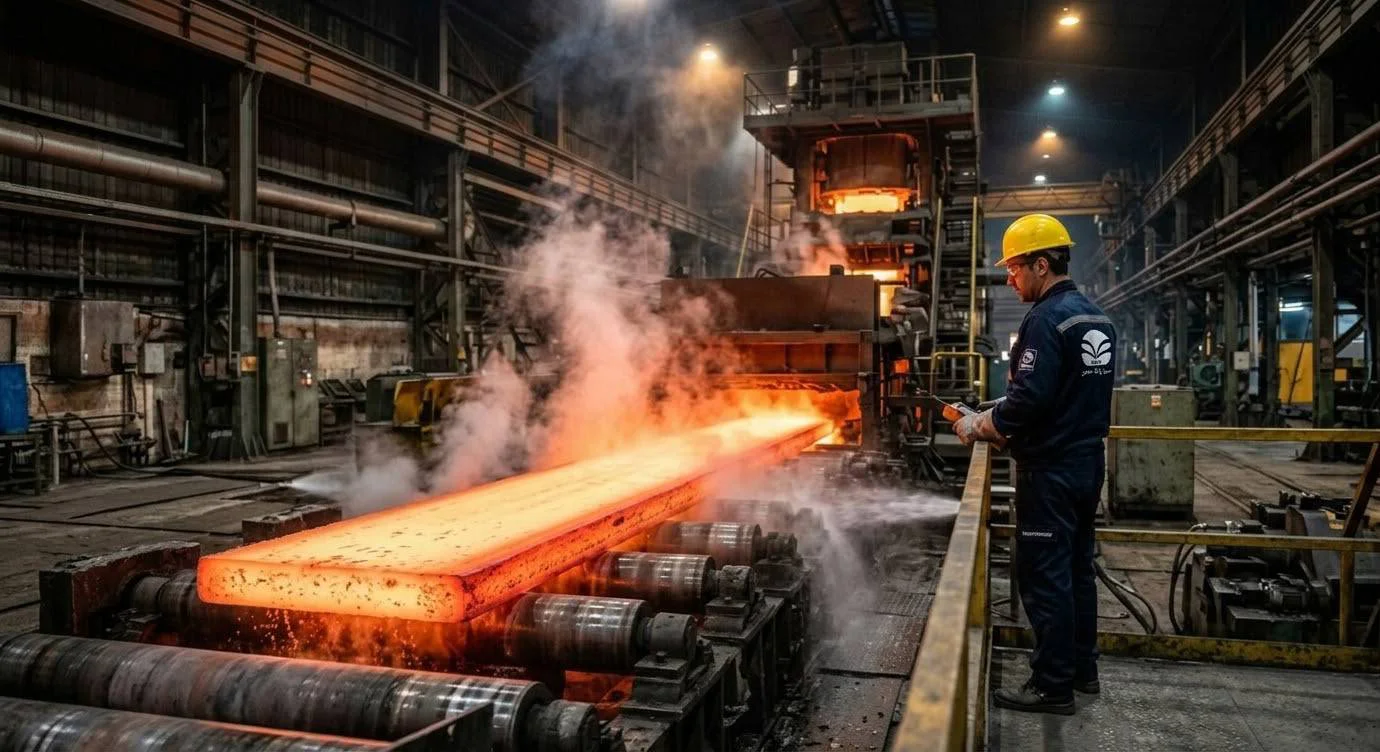
How is the Continuous Slab Casting Process Performed?
Continuous slab casting is one of the most critical stages in the production of flat steel products, where molten steel is continuously fed into a casting machine and, following gradual solidification, takes the form of a steel slab. The quality of this process directly impacts the quality of the final product, including steel sheets and plates.
In this method, after preparation and chemical composition adjustment, the molten steel is transferred from the ladle to the tundish and subsequently into a water-cooled copper mold. After the formation of an initial shell, the slab enters the secondary cooling zone, where it gradually solidifies completely by passing through a series of rollers and cooling systems. Finally, the slab is cut to the desired length and prepared for subsequent production stages.
Stages of Continuous Slab Casting
Continuous slab casting comprises an interconnected series of operations beginning with the transfer of molten steel and continuing through complete solidification and slab cutting. The primary stages of this process are:
-
Following steelmaking processes and melt preparation, the steel inside the ladle is transferred to the continuous casting machine. The molten steel first enters the tundish.
The tundish serves as an intermediate reservoir that feeds the flow of molten steel into the mold at a controlled rate. It also allows the flow of steel to continue during ladle changes and assists in controlling melt flow dynamics.
-
Entry of Molten Steel into the Copper Mold
From the tundish, molten steel passes through a nozzle into a water-cooled copper mold. The mold is equipped with a cooling system that rapidly extracts heat from the molten steel.
At this stage, the molten steel begins to solidify upon contact with the mold walls, forming a solid initial shell around the liquid core. This shell must possess sufficient strength to contain the remaining liquid steel further along the path.
One of the critical factors at this stage is controlling the molten steel level inside the mold as well as the casting speed. Fluctuations in these parameters can adversely affect the surface quality of the slab.
-
Secondary Cooling and Slab Formation
Upon exiting the mold, only the outer shell of the steel strand is solidified, while the center may still contain liquid steel. Consequently, the steel strand enters the secondary cooling zone.
In this section, water or an air-water mist is sprayed onto the surface of the steel strand via nozzles to lower its temperature and continue solidification. The cooling intensity must be regulated according to factors such as steel grade, slab dimensions, and casting speed.
The goal is not merely rapid cooling; temperature and cooling rates must be carefully controlled to minimize the risk of surface and internal cracks, deformation, and other metallurgical defects.
-
Guidance and Withdrawal of the Steel Strand
Along the path, a series of support and withdrawal rolls guide the steel strand and transport it through the machine at a specified speed. In addition to guiding the strand, these rolls support the solidifying shell against the ferrostatic pressure of the internal molten steel.
In machines with a curved profile, after traversing designated sections of the strand path, the steel strand is gradually straightened to reach an appropriate orientation for discharge and cutting.
-
Completion of Solidification and Slab Production
As cooling and strand movement proceed, the solidification front advances toward the center of the slab until the core becomes completely solid.
Thus, slab production in continuous casting is not instantaneous; rather, solidification initiates at the mold walls and continues along the machine path until the entire slab cross-section is fully solidified.
Once solidification is complete, the slab is ready for cutting and transfer to the next stage.
-
Cutting the Slab to Desired Length
After passing through the cooling, withdrawal, and straightening sections, the slab is fully solidified and reaches the cutting area.
At this stage, the continuous slab is divided into required lengths using cutting torches or mechanical shearing equipment. The final length is determined based on order specifications and production line requirements.
Following cutting, the slabs are transferred via conveyance equipment, such as roller tables, to the respective department for hot rolling and flat product manufacturing.
Key Factors Influencing Continuous Slab Casting Quality
The quality of the produced slab does not depend solely on the equipment, but on the simultaneous control of several operating parameters. The most critical factors include:
- Molten steel temperature and proper thermal control
- Casting speed
- Primary and secondary cooling rates and patterns
- Liquid steel level control in the mold
- Copper mold condition and performance
- Chemical composition and steel grade
- Performance of support rolls and withdrawal system
- Proper control of the solidification process
Improper control of temperature or cooling can induce thermal stresses and increase the likelihood of cracks and other slab defects. Therefore, thermal control along the entire casting path is essential for obtaining high-quality slabs.
Differences Between Continuous Slab Casting and Ingot Casting
In ingot casting, molten steel is poured into individual molds and stripped after solidification. The ingots are then typically transferred to facilities such as slabbing mills for soaking, reheating, and primary rolling.
In contrast, in continuous slab casting, molten steel flows from the tundish into a water-cooled copper mold and is continuously transformed into slabs. Consequently, intermediate steps such as ingot molding, stripping, and primary rolling are eliminated or significantly reduced. This results in lower energy consumption, higher productivity, and improved metallic yield.
| Criterion | Continuous Slab Casting | Ingot Casting |
| Production Method | Continuous and direct slab formation | Ingot production in separate molds |
| Primary Rolling | Requirement for primary rolling is usually reduced/eliminated | Typically required after ingot casting |
| Production Stages | Shorter and more continuous | More intermediate stages |
| Energy Consumption | Generally lower | Generally higher |
| Metallic Yield | Generally higher | Lower due to cropping and discarded sections |
| Process Control | Continuous control of temperature, speed, and solidification | Discreet control across separate stages |
Summary
Continuous slab casting is a continuous process for converting molten steel into steel slabs, starting from melt transfer to the tundish and continuing through controlled entry into a copper mold, initial shell formation, secondary cooling, strand guidance, complete solidification, and final cutting.
Precise control of molten steel temperature, casting speed, mold conditions, and the cooling system plays a crucial role in final slab quality. Once cut, the produced slabs serve as raw material for subsequent processes, particularly hot rolling.
If you require professional guidance for steel slab procurement, technical specification reviews, or price inquiries, you can contact Hamgar Holding to receive expert advice regarding your required specifications and procurement process.
Frequently Asked Questions (FAQ)
-
What is continuous slab casting?
It is a process in which molten steel is continuously fed into a mold and, after gradual cooling and solidification, is transformed into steel slabs.
-
Where does slab solidification begin in the machine?
Slab solidification begins at the walls of the water-cooled copper mold and continues through the secondary cooling zone.
-
What is the role of secondary cooling in slab production?
This system reduces the temperature of the steel strand after it leaves the mold, helping to progress and control the solidification process.
-
What happens to the slab after casting?
Upon complete solidification and cutting, the slab can be used for downstream processes such as hot rolling to manufacture flat steel products.
-
Why is controlling casting speed important?
Casting speed affects the residence time of the steel strand in different cooling zones, directly influencing solidification conditions and slab quality. Therefore, it must be carefully controlled in accordance with process parameters.